If I could start all over again...
I would first seek the Statistician's advise and also the Social Scientist's advise before proceeding any further to plan and conduct a survey.
I would not be so short-sighted as to forget human emotions, human favors and the most humane way of doing things. For example, I no longer needed to survey Prof. Bernard Tan's and Dr. Pow's lecture classes anymore, but I should have still done it after they have agreed to it. Such that I will not make myself and my department and my Professor look stupid and also lose credibility.
I would be more realistic and less idealistic about completing tasks. This is one of my weakness, I have such great faith in things that do not warrant my faith at all.
I will not be a scaredy cat but to be more brave and manage my image less, so as not to miss out on opportunities to ask questions and to learn.
In a short span of a week, we visited Prof. Chua Tin Chiu, a very kind and humorous Professor who shared many anecdotes and advise on sampling. We decided not to survey the 2 lecture classes anymore. We decided to generate a list of the whole undergraduate population and pick a random sample of 5000 to email them. And then, we decided not to do it anymore and just take the results of the one class which I managed to perform the survey on, my own SSS1207 class.
In a short span of 2 days, with a little help from my friends, we got all the data into the excel file and I passed over the baton to Xingli, my mentor to analyze.
It has been a strange journey.
I am indebted to Prof. Bernard Tan and Dr. Pow. They have been so kind, so patient and so generous towards me. I must remember to wish them a Happy Christmas at the end of the year.
I am also very grateful for my Professor and mentors for their patience and care for a very inexperienced, very slow and not-so-smart student.
Tuesday, February 26, 2008

Tuesday, February 19, 2008
An Update
This blog badly needs an update if its purpose is to document my experience of doing a research project!
So far, I have managed to complete creating a 4-pages long questionnaire. Initially it was 8-pages long but with my Professor's help, it was shrunk to half its original length. That is good news for the trees! ;)
I managed to get permission from 3 lecturers to agree to allow me time to conduct my survey during their lessons. These are lecturers who have once taught me before and this I believe made them more compassionate towards me. The lecturers I emailed who have never met me, rejected me due to time constraints and one Statistics Professor rejected me as he disagreed on my methodology.
I learnt the importance of communication, being able to express myself well in English and also to have good written body language. This is actually one weakness I've struggled with since I was a child. English has always been my weakess subject and I have never managed to get the top grade for it. It was something I could never improve as I did not know how to study for it. Reading did not help me much either as I has always been a very avid reader. Prof. suggested writing 15 minutes a day, a proven method which has boosted a fellow student's grades up, which I seriously am considering!
I have photocopied 1000 copies of my survey forms and they lie waiting for their recipients to fill them in.
The next step would be to toughen my skin, take courage and stand firm. I would need perseverance and courage to speak to the whole LT to do my survey, meet the Statistics Professor to ask for help and to meet the tight deadline in the midst of other responsibilities.
This research project has really challenged my timidity and many times I find myself facing my inadequacies and insecurities. Being naturally timid and nervous, it was not easy even approaching my Professor or emailing another, nor am I very used to accepting corrections and criticisms. It was very scary for me today when I had to call a Statistics professor and speak to him over the phone (way more scarier than writing an email).
Though through a phone call, more "body language" can be passed on to the recipient, such as humility, sincerity, understanding, appreciation etc., yet to one like me, it also means the transference of my poor communication ability, my fear and insecurities. So this is something I must actively deal with as I do my research, to continue to improve my communication skills and becoming more confident and courageous.
As you can see, this project is challenging me in many areas, intellectually, socially and emotionally.
So here is a behind the scenes look at what a project such as this entails. I am very grateful for all the help offered to me and the kind understanding by my supervisors.
So far, I have managed to complete creating a 4-pages long questionnaire. Initially it was 8-pages long but with my Professor's help, it was shrunk to half its original length. That is good news for the trees! ;)
I managed to get permission from 3 lecturers to agree to allow me time to conduct my survey during their lessons. These are lecturers who have once taught me before and this I believe made them more compassionate towards me. The lecturers I emailed who have never met me, rejected me due to time constraints and one Statistics Professor rejected me as he disagreed on my methodology.
I learnt the importance of communication, being able to express myself well in English and also to have good written body language. This is actually one weakness I've struggled with since I was a child. English has always been my weakess subject and I have never managed to get the top grade for it. It was something I could never improve as I did not know how to study for it. Reading did not help me much either as I has always been a very avid reader. Prof. suggested writing 15 minutes a day, a proven method which has boosted a fellow student's grades up, which I seriously am considering!
I have photocopied 1000 copies of my survey forms and they lie waiting for their recipients to fill them in.
The next step would be to toughen my skin, take courage and stand firm. I would need perseverance and courage to speak to the whole LT to do my survey, meet the Statistics Professor to ask for help and to meet the tight deadline in the midst of other responsibilities.
This research project has really challenged my timidity and many times I find myself facing my inadequacies and insecurities. Being naturally timid and nervous, it was not easy even approaching my Professor or emailing another, nor am I very used to accepting corrections and criticisms. It was very scary for me today when I had to call a Statistics professor and speak to him over the phone (way more scarier than writing an email).
Though through a phone call, more "body language" can be passed on to the recipient, such as humility, sincerity, understanding, appreciation etc., yet to one like me, it also means the transference of my poor communication ability, my fear and insecurities. So this is something I must actively deal with as I do my research, to continue to improve my communication skills and becoming more confident and courageous.
As you can see, this project is challenging me in many areas, intellectually, socially and emotionally.
So here is a behind the scenes look at what a project such as this entails. I am very grateful for all the help offered to me and the kind understanding by my supervisors.
Thursday, February 14, 2008
Insensitivity towards Ah Meng
I was really amused and disappointed by a short forum letter found on the newspaper on Wednesday, 13th of February. A reader wrote in his fears that Ah Meng's decomposing body, being buried near the Seletar Reservoir, would contaminate the water supply.
I felt that this was a very very insensitive letter. Many people are saddened about Ah Meng's death, so many attended her funeral. It is extremely untimely to be thinking about something like this during this period and even writing to the forum to aggravate grieving people.
I'm amazed that the forum editor allowed it to go through.
This really shows how little people understand about the cycle of life but more so their insensitivity towards the feelings of people.
All things must pass away. So do the fishes in the reservoir. So do the birds in the forest surrounding the reservoir. So do the insects and the toads and the plants and the lizards that roam the areas around the reservoir. No one ever complains about their decomposing bodies posing a hazard to the water supply. This is because the organic material will be recycled and become detritus and nutrients to sustain many cycles and food chains. Why is it that Ah Meng's body is special and must be brought up to the attention of Straits Times readers? And I believe, Ah Meng's body was placed in a coffin, like a proper burial would have.
Lim Bo Seng is also buried near MacRitchie reservoir. I wonder if some people worry about it as well.
Just food for thought. I did not know such a short and tiny letter would stimulate such great reaction in me.
I felt that this was a very very insensitive letter. Many people are saddened about Ah Meng's death, so many attended her funeral. It is extremely untimely to be thinking about something like this during this period and even writing to the forum to aggravate grieving people.
I'm amazed that the forum editor allowed it to go through.
This really shows how little people understand about the cycle of life but more so their insensitivity towards the feelings of people.
All things must pass away. So do the fishes in the reservoir. So do the birds in the forest surrounding the reservoir. So do the insects and the toads and the plants and the lizards that roam the areas around the reservoir. No one ever complains about their decomposing bodies posing a hazard to the water supply. This is because the organic material will be recycled and become detritus and nutrients to sustain many cycles and food chains. Why is it that Ah Meng's body is special and must be brought up to the attention of Straits Times readers? And I believe, Ah Meng's body was placed in a coffin, like a proper burial would have.
Lim Bo Seng is also buried near MacRitchie reservoir. I wonder if some people worry about it as well.
Just food for thought. I did not know such a short and tiny letter would stimulate such great reaction in me.
Tuesday, January 29, 2008
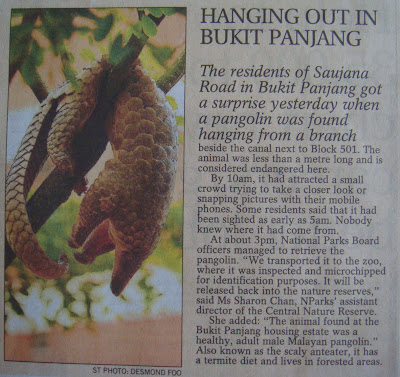
Pangolin spotted in Bukit Panjang
 |
| From pangolin arti... |
Found this in today's Straits Times. Just wanted to highlight the reaction of the residents. This pangolin had "attracted a small crowd trying to take a closer look or snapping pictures with their mobile phones."
I sincerely believe that many Singaporeans lack exposure to nature and that many are interested to find out more but either lack the means or the time to do so. I consistently realise this with conversations with my friends. Venetia whom I just met is interested to visit Chek Jawa to walk on the mud flats but after realizing she has to find a group and pay for it, she hesitated.
So this must be a plus point for biological conservation. Not indifference, but interest.
According to my natural heritage textbook, it's actually quite a rare occurence to see this beauty as they are shy nocturnal animals that sleep in underground burrows during the day. These manmmals wear an armour of large, overlapping scales, which are made of fused hair. They roll themselves into a ball projecting their scales outward in an intimidating pose when they are threatened to protect their soft, naked, underparts within. They are versatile and are found in primary and secondary forests and I guess in our case, even in urban areas! :)
Monday, January 28, 2008
Biological Conservation
What is biological conservation?
It is the conservation of biodiversity which is the full spectrum of living organisms and the variability of nature. The aim of biological conservation is to maintain the diversity of living organisms and their environments and also the interactions between the two.
Why is it important?
I was casually asking a few of my friends whether they think biological conservation was important and I was actually quite rather surprised with their replies. I cannot remember exactly what they told me but roughly along the lines of morality, education and religion.
Hanes was telling me that it was morally right to protect biodiversity. That nature has its intrinsic value whether or not they bring us benefits.
Zhixin was going along the lines that such conservation is essential for education and also to ensure future generations get to enjoy nature.
Huanyan asked me whether God would want us to conserve the biodiversity and it made me think for a while. For this is not an issue that organized religion focus a lot on. We might talk about cloning, or abortion, but biological conservation of species? It's not something discussed as a ethical or moral issue in my religion. So I talked about stewardship. I told Huanyan that that I believed God would want us to take care of the things we have on earth, not to be irresponsible and destructive to the things we own.
Other than education, moral and religious motivations towards biological conservation, people desire to conserve also for nature's aesthetic values, ecological and utilitarian reasons.
I for one would purely conserve because nature is beautiful. It's not everyday that I remember to smell the flowers or follow the outline of a fern, but when I do, it's one of the most amazing experience. Talking to birds and plucking wildflowers/weeds and just taking in deep breaths of fresh air, whether humid rain forest air, or salty mudflats or rotten mangrove wafts, they have therapeutic rewards for those who would only slow down and just for a moment appreciate the wonders of life.
Recently I took a video of mudskippers fighting and in courtship. It was fascinating trying to interprete what they were trying to do. And amazing that I could have a bird's eye view to capture that scene from the broadwalk of Sungei Buloh Wetland Reserve.
Other people conserve because biodiversity is a utility, a resource for food, medication, research inspiration and other needs Mankind might have.
Still others who are more farsighted conserve because biodiversity plays an important role in maintaining the environment, whether ecosystems or climate. When we remove the living organisms that interact with their habitat, we are unknowingly supporting threats like global warming, landslides, harmful weather conditiions and CO2/O2 imbalances. Because both the biotic (living) and abiotic (non-living) factors are required to interact in meaningful ways to maintain our ecological systems.
It is the conservation of biodiversity which is the full spectrum of living organisms and the variability of nature. The aim of biological conservation is to maintain the diversity of living organisms and their environments and also the interactions between the two.
Why is it important?
I was casually asking a few of my friends whether they think biological conservation was important and I was actually quite rather surprised with their replies. I cannot remember exactly what they told me but roughly along the lines of morality, education and religion.
Hanes was telling me that it was morally right to protect biodiversity. That nature has its intrinsic value whether or not they bring us benefits.
Zhixin was going along the lines that such conservation is essential for education and also to ensure future generations get to enjoy nature.
Huanyan asked me whether God would want us to conserve the biodiversity and it made me think for a while. For this is not an issue that organized religion focus a lot on. We might talk about cloning, or abortion, but biological conservation of species? It's not something discussed as a ethical or moral issue in my religion. So I talked about stewardship. I told Huanyan that that I believed God would want us to take care of the things we have on earth, not to be irresponsible and destructive to the things we own.
Other than education, moral and religious motivations towards biological conservation, people desire to conserve also for nature's aesthetic values, ecological and utilitarian reasons.
I for one would purely conserve because nature is beautiful. It's not everyday that I remember to smell the flowers or follow the outline of a fern, but when I do, it's one of the most amazing experience. Talking to birds and plucking wildflowers/weeds and just taking in deep breaths of fresh air, whether humid rain forest air, or salty mudflats or rotten mangrove wafts, they have therapeutic rewards for those who would only slow down and just for a moment appreciate the wonders of life.
Recently I took a video of mudskippers fighting and in courtship. It was fascinating trying to interprete what they were trying to do. And amazing that I could have a bird's eye view to capture that scene from the broadwalk of Sungei Buloh Wetland Reserve.
Other people conserve because biodiversity is a utility, a resource for food, medication, research inspiration and other needs Mankind might have.
Still others who are more farsighted conserve because biodiversity plays an important role in maintaining the environment, whether ecosystems or climate. When we remove the living organisms that interact with their habitat, we are unknowingly supporting threats like global warming, landslides, harmful weather conditiions and CO2/O2 imbalances. Because both the biotic (living) and abiotic (non-living) factors are required to interact in meaningful ways to maintain our ecological systems.
Tuesday, January 8, 2008
Order of Scientific Research
- Find a topic to study
- Develop research questions and hypothesis
- Specify how to measure the variables in your hypotheses (operationalize)
- Design a questionnaire
- Develop a sample
- Collect data
- Prepare a code book and data file
- Enter survey results in the data file
- Analyze data statistically
- Write up and present the results and conclusions
A little update on my progress. It's been a little slow.
But basically, the topic was given to me. :)
I have been spending the past days thinking about my research questions and came up with two:
1. What are the attitudes and perceptions of Singaporeans towards biological conservation?
2. What are the predictors of attitudes and perceptions towards biological conservation?
And I am doing literature review now. And trying to read up more about statistical research from some books.
I am currently quite interested in quantifying attitudes under attitudes, concern and behaviour through asking questions that might reveal those 3 aspects. (Hunter, 2000)
But there is also another method of classifying attitudes. Kellert's 9 basic attitudes (Kellert, 1993) include:
Aesthetic
Dominionistic
Ecologistic
Humanistic
Moralistic
Naturalistic
Negativistic
Scientistic
Utilitarian
And some researchers even created their own scales to test attitudes after failing badly using Cronbach's alpha to check consistency. (Caro, Pelkey and Grigione, 1994)
So there you have it. Some factor analysis. Some Cronbach's alpha. Many ways to quantify attitudes and that's what I'm doing, exploring the written literature, to find out what others have already done, how they did it, to get ideas how I can do mine. Many new terms and ways of thinking encountered so far. But greatly appreciate this opportunity to at least think with the mind of a Scientist.
References
Caro, T.M., Pelkey, N. and Grigione, M. 1994. Effects of Conservation Biology Education on Attitudes Toward Nature. Conservation Biology 8: 846-852
Hunter L.M. (2000) A Comparison of the Environmental Attitudes, Concern, and Behaviors of Native-Born and Foreign-Born U.S. Residents. Population and Environment: A Journal of Interdisciplinary Studies 21:565-580
Kellert, S. R. (1993) Values and Perceptions of Invertebrates. Conservation Biology 7: 845-855
Saturday, January 5, 2008
The plight of the Albizias
There was a recent slew of letters and articles about the Albizia trees in Singapore.
 My earliest recollection of the Albizia trees was when Bingwen, the bird watcher, pointed them out to me in NJC. He told me these mature big trees are home to many of the birds in NJC. The cockatoos even build their nests in the hollow of the trunks of these trees. Ever since that, I have been mildly interested in these trees.
 The Albizia (Paraserianthes falcataria) are extremely fast-growing, soft wood trees, introduced from Indonesia. According to Adrian Loo's letter to the Sunday Times, they have a "shallow root system and expansive crown" making them "susceptible to damage by wind" and hence dangerous to mankind and property, "especially during the current rainy season." As a result, the SLA and NParks had earmarked 63 Albizia trees in South Buona Vista Road to be cut down. One species had already taken the life of a dental assistant in May last year.
However, to the tree-huggers, this was a very painful thing for them. As these trees are big, beautiful, shady. It was also painful for the nature-lovers who stress that these trees provide many nationally endangered bird species such as the changeable hawk eagle and the grey-headed fish eagle with nesting sites and places to perch and roost outside the nature reserves. Therefore these Albizias play a very "important ecological role in the Singapore coun tryside."
 tryside."
 The SLA and NParks responded to the public and eventually cut down the number of trees to be chopped down to 13. These trees were in more dangerous locations due to their "proximity to residential areas and roads, poor condition or leaning position."
It is fascinating that these non-native, very common trees, can elicit so much response from the public. And there are so many different view-points in which one can approach this topic. I was reading a journal entry about how researchers have found out that most U.S. citizens had limited ecological understanding of the environment and their concern for wildlife were largely confined to "attractive and emotionally appealing species." So could this be a reason why the tree huggers were hugging these Albizias rather than other more endangered species?
Or is it a knee-jerk reaction that comes with the news of their impending removal? Just like how if one is going to tear down a historically important architecture, there will also be an uproar by the public about it.
Are these people truely interested in the ecological role that these trees play?
For me, I'm thankful for this chance to view this subject more objectively, after reading about it from the papers, and hearing Prof Hugh Tan and his lab denizens, chatting about it. Prof Tan even received a phone call and a Christmas card from these Albizia-lovers, which I witnessed during my short time in the lab on Thursday, 3/1/08.
My natural instinct would be to protect all that would be going to be destroyed. But now, I would consider the appropriateness of that choice, based on the characteristics of the plant, and the ecological role that it plays, and also how best to do it such that the environment would not get a shock from the sudden removal of its residents.
And to add, the issue is very much about human lives as well. Consider a human life and a tree. I would very much prefer to redeem a human life for a tree, even if the tree is very rare and significant. I wouldn't want anyone to lose or risk losing a loved one because I insisted on the value of a tree. And I too am a lover of nature.

Are these Albizias? They were fallen along AYE towards Jurong.
Subscribe to:
Posts (Atom)
